


Los Angeles Workplace Discrimination Attorneys Who Hold Employers Accountable
Discrimination on the job does more than hurt a paycheck. It chips away at your dignity, your health, and your ability to provide for the people who depend on you. The problem is far from rare: the U.S. Equal Employment Opportunity Commission received 91,503 new charges of workplace discrimination in fiscal year 2025, and California accounted for 5.4% of those charges nationwide, one of the highest shares of any state.
At Cohen & Marzban, our seasoned employment litigators are ready to take on the corporations, human resources departments, and defense firms that too often protect the company instead of the worker. Our legal team pairs deep command of California employment law with a proven track record of results, and we use that combination to pursue the money and justice mistreated employees are owed.
What Is Employment Discrimination
Employment discrimination happens when an employer treats a worker or job applicant less favorably because of a legally protected trait rather than performance or qualifications. It can surface at any stage of the job, from hiring and pay to promotions, assignments, discipline, and firing. A knowledgeable employment attorney looks past the excuse an employer offers and focuses on the real reason behind the decision.
Unlawful treatment is rarely labeled as bias. An employer usually offers a lawful-sounding reason, such as performance, budget cuts, or "fit", to cover a decision that was really about a protected trait. California law gives you the right to challenge that cover story, and we can explain what challenging it looks like in your situation.

Workplace Discrimination vs. Harassment: What's the Difference
People use these terms interchangeably, but they describe different wrongs that our attorneys often see overlap in one case. Discrimination is unequal treatment: a decision about who gets hired, paid, promoted, or fired based on a protected trait. Harassment is hostile conduct tied to that same trait, such as slurs, jokes, or advances that make the workplace abusive.
The difference shapes what you must prove. A discrimination claim turns on a job action and the reason behind it, while a harassment claim turns on conduct so severe or pervasive that it alters your working conditions. Many employees face both, and we can pursue every claim the facts support.
Signs You're Experiencing Workplace Discrimination
Bias rarely announces itself, so it helps to know the warning signs our legal team looks for. If several of these patterns fit your situation, take a closer look:
- A pattern of being passed over. Less-qualified coworkers keep landing the promotions, raises, or plum assignments you were in line for.
- Different rules for different people. You're disciplined for conduct that others get away with, or held to standards that don't apply to your peers.
- Comments tied to who you are. Remarks about your age, accent, religion, pregnancy, disability, or background creep into everyday conversation.
- Backlash after you spoke up. Your treatment soured right after you reported bias, requested an accommodation, or asked about pay.
- Sudden changes to your record. Years of solid reviews give way to a wave of write-ups with no real change in your work.
- Exclusion and isolation. You're cut out of meetings, training, or communications that others in your role receive.
None of these signs guarantees a claim on its own, but together they can point to unlawful treatment. Our team can review the facts and tell you where you stand.
Common Types of Workplace Discrimination We Handle

Bias takes many forms, and each category carries its own proof requirements and legal nuances. We stand up for employees in every protected class recognized under state and federal law, including the situations described below.
Which California Laws Shield Employees from Workplace Discrimination
California gives workers some of the strongest anti-discrimination protections in the country, layered on top of federal law. Knowing which statute applies to your situation shapes your deadlines, your remedies, and your strategy, and our legal team builds that roadmap for you from day one.
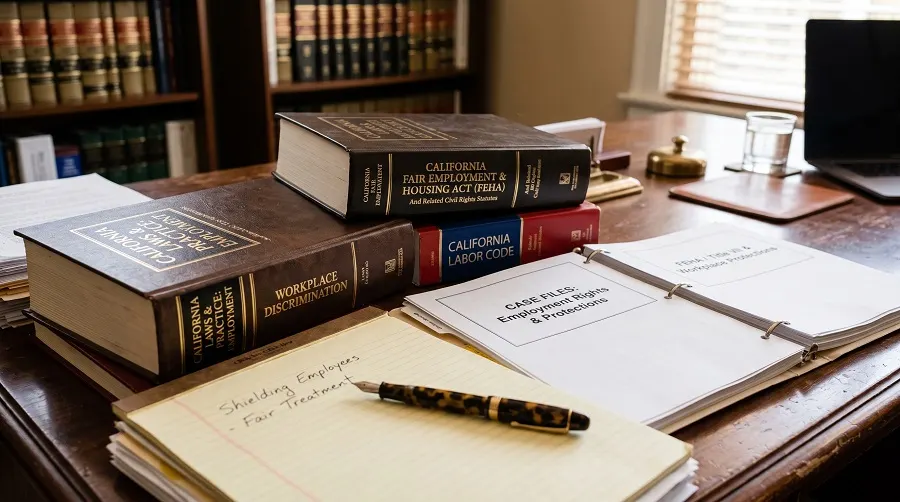
The Fair Employment and Housing Act (FEHA)
The Fair Employment and Housing Act is the backbone of state protection. It bars discrimination by employers with five or more workers and covers race, color, national origin, ancestry, religion, sex, gender, sexual orientation, age (40+), disability, medical condition, pregnancy, marital status, military status, and genetic information. FEHA reaches conduct that federal law sometimes misses.
Title VII and Other Federal Protections
Federal statutes such as Title VII of the Civil Rights Act, the Americans with Disabilities Act, and the Age Discrimination in Employment Act add another layer of coverage enforced through the EEOC. Many cases qualify under both systems, and we decide which path gives you the strongest position.
Equal Pay and Related State Rules
The California Equal Pay Act requires equal pay for substantially similar work regardless of sex, race, or ethnicity. Related rules protect against retaliation and require fair treatment during leave, giving us several tools to pursue full recovery.
How Can I Prove Discrimination at Work
Few employers admit bias out loud, so most cases are built from a mosaic of evidence rather than a single confession. We gather and connect that evidence to show what really drove the employer's decision.
Direct Evidence
Occasionally an employer leaves behind an email, text, or recorded remark that openly ties a decision to a protected trait. This kind of proof is powerful but uncommon, which is why the other categories matter so much.
Circumstantial Evidence
Most claims rest on patterns: shifting explanations for the same decision, discipline that lands harder on some workers than others, a paper trail that contradicts the company's story, or numbers that reveal a lopsided outcome. A skilled employment lawyer knows how to assemble these pieces into a persuasive whole.
The Burden-Shifting Framework
California courts often use a step-by-step framework in which you present enough facts to suggest discrimination, the employer offers a supposed reason, and you then show that reason is a pretext. We handle each stage and keep the pressure on the employer to explain itself.
What Damages Can I Recover for Workplace Discrimination

A successful claim can compensate you for real financial harm, and the personal toll bias takes on your life. Our workplace discrimination lawyers in Los Angeles pursue every category California law allows so you can move forward on solid footing.
How Can a Los Angeles Workplace Discrimination Attorney Help with My Case
Handling a discrimination claim alone against a well-resourced employer is an uneven fight. Our attorneys manage every stage so you can keep your focus on your health, your family, and your next opportunity.

Investigation and Evidence Preservation
We secure personnel files, internal messages, pay records, and witness accounts before they can vanish, then build a factual record that stands up to scrutiny.
Administrative Filings
We prepare and file the required complaints with the California Civil Rights Department or the EEOC and obtain the right-to-sue notice that clears the way for a lawsuit.
Negotiation and Settlement
Most claims resolve without trial. Our team knows how employers value cases and negotiates from a position of strength to secure a fair figure.
Litigation and Trial
When a company refuses to do right by you, we are prepared to take the matter to court, handling discovery, depositions, expert witnesses, and trial before a judge and jury.
Employees We Stand Beside
Discrimination reaches into every industry and pay grade. We represent hourly and salaried employees, professionals, and public-sector workers, including firefighters, law enforcement personnel, and other first responders who face on-the-job bias. Whatever your role, you deserve an advocate who takes your case as seriously as it demands.


